

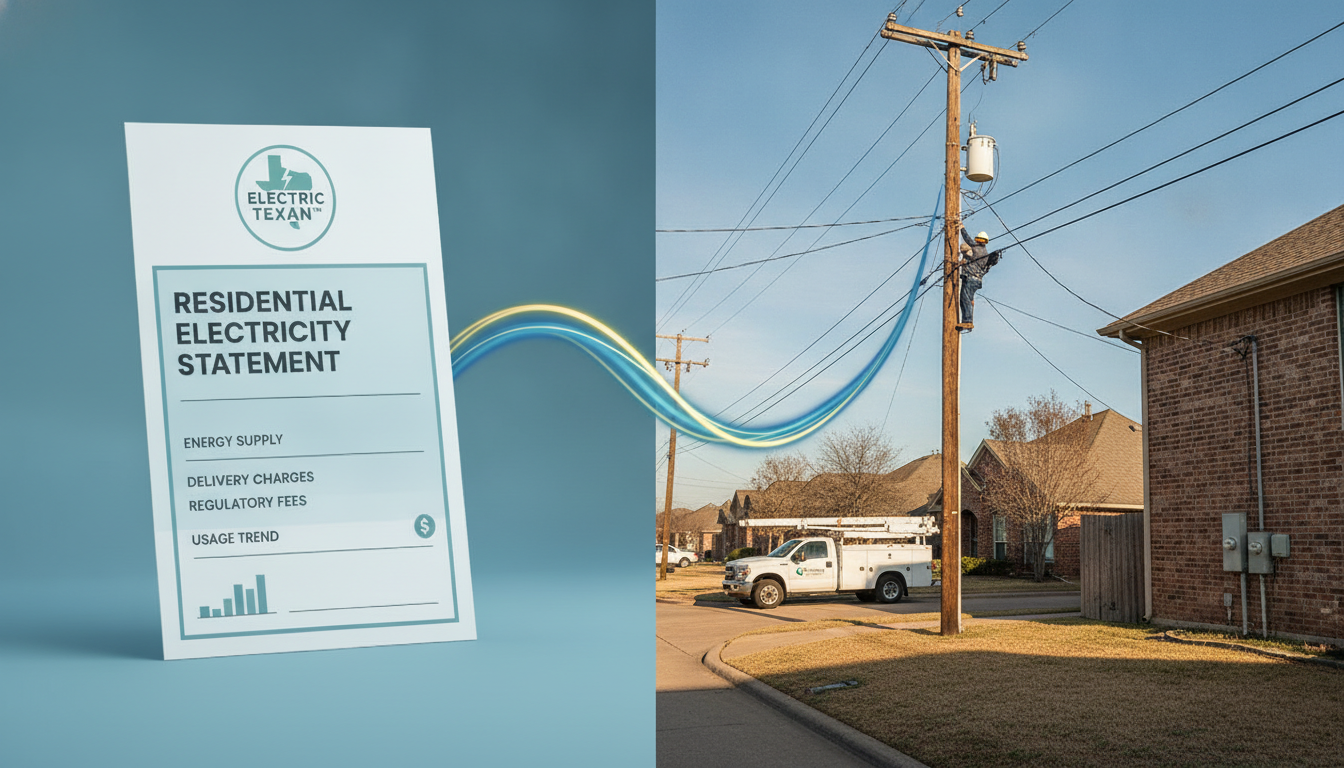
Ever stared at your Texas electricity bill and wondered why certain line items seem to appear no matter which retail provider you choose? You’re not alone. Many hardworking Texans find the intricacies of the deregulated energy market a maze, especially when it comes to distinguishing between the company that sends your bill and the entity that actually delivers the power to your home. Today, we’re pulling back the curtain on a key component of your bill, specifically focusing on the infrastructure costs managed by your local utility.
Understanding Your Texas Electricity Bill: Supply vs. Delivery
In the deregulated ERCOT marketplace, you enjoy the ‘Power to Choose’ your Retail Electric Provider (REP) – the company that supplies the actual electricity and manages your billing contract. This is where you compare different plans, rates, and customer service options. However, your chosen REP doesn’t own or maintain the physical poles, wires, or substations that bring electricity from the grid to your home. That crucial role belongs to a Transmission and Distribution Service Provider (TDSP).
For residents in the Houston metropolitan area and surrounding regions, your TDSP is CenterPoint Energy. These regulated utility companies are responsible for the physical infrastructure: building, maintaining, and repairing the entire delivery network. Think of them as the highway system for electricity – they ensure the roads are clear and functional, regardless of which car company you lease from.
The Uniformity of CenterPoint Energy TDSP Pass Through Charges
Here’s a vital piece of information that can demystify your electricity statement: the CenterPoint Energy TDSP pass through charges on your bill are completely uniform across their service territory. This means that whether you sign up with a premium-priced provider or a budget-friendly option found on Electric Texan™, the charges from CenterPoint Energy for transmitting and distributing electricity will remain 100% identical.
These charges, approved and regulated by the Public Utility Commission of Texas (PUCT), cover the costs associated with maintaining the massive infrastructure – the poles, lines, transformers, and smart meters – that keeps your lights on. They typically include volumetric distribution delivery costs, fixed monthly customer charges, and regulated transmission factors. Because these are regulated costs, they are simply